
Could AI Data Centers Move to Space?
3 Mins Read
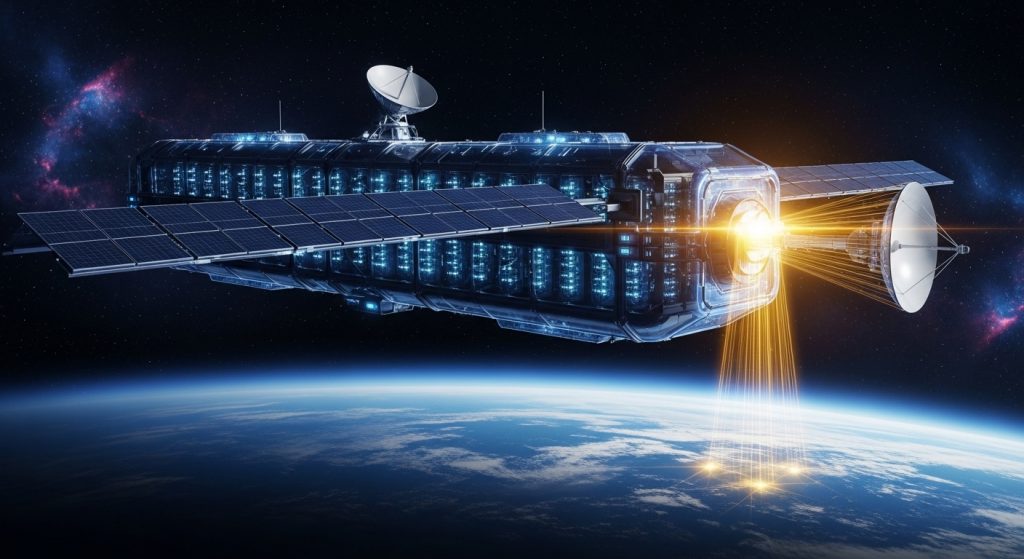
AI is running into a very real limit — not intelligence, but infrastructure.
As demand for compute grows, data centers are consuming massive amounts of energy, land, and cooling resources. A new idea explored by Wired asks a question that sounds extreme but increasingly practical:
What if we moved AI data centers into space?
It’s early, experimental, and full of challenges — but the idea highlights just how far the AI infrastructure problem has grown.
Why Data Centers Are Becoming a Problem
Modern AI systems require:
- massive GPU clusters
- continuous power supply
- advanced cooling systems
- large physical space
As AI adoption grows, so do concerns around:
- energy consumption
- carbon emissions
- land availability
- strain on power grids
In some regions, data centers are already competing with cities for electricity.
Why Space Is Being Considered
Placing data centers in space could, in theory, solve several of these problems.
1. Unlimited Solar Energy
In orbit, solar panels can generate continuous power without weather interruptions.
2. Natural Cooling
The vacuum of space could help dissipate heat more efficiently than Earth-based systems.
3. Reduced Land Constraints
No need for physical land or proximity to urban infrastructure.
4. Dedicated Infrastructure
Space-based systems would not compete with civilian energy demands.
The Technical Reality
Despite the potential, building data centers in space is extremely complex.
Key challenges include:
- launching heavy hardware into orbit
- maintaining and repairing systems remotely
- managing data transmission latency
- protecting equipment from radiation
- ensuring long-term reliability
Even minor hardware failures become major issues when systems are off-planet.
The Cost Factor
Launching infrastructure into space is still expensive.
Although costs have decreased due to reusable rockets, deploying large-scale data centers would require:
- significant upfront investment
- specialized hardware design
- ongoing operational support
At present, Earth-based data centers remain far more economical.
The Role of AI and Edge Computing
Interestingly, the push toward space-based infrastructure connects to broader trends:
- distributed computing
- edge processing
- satellite networks
- global connectivity systems
Companies are already exploring satellite-based data processing for specific use cases.
However, full-scale AI training infrastructure in space remains a long-term concept.
The Bigger Picture: AI Is Becoming Physical Infrastructure
The idea of space-based data centers reflects a deeper shift.
AI is no longer just software — it is:
- energy-intensive
- hardware-dependent
- geographically constrained
As demand grows, companies are exploring increasingly unconventional solutions.
This includes:
- nuclear-powered data centers
- underwater facilities
- and now, potentially, space-based systems
What’s Next?
In the near term, expect:
- continued expansion of Earth-based data centers
- investment in renewable energy solutions
- more efficient chip design
- improved cooling technologies
Space-based data centers may remain experimental for years, but early research could shape future infrastructure strategies.
Conclusion: A Signal, Not a Solution (Yet)
The idea of AI data centers in space may sound futuristic, but it reflects a real constraint.
The limiting factor in AI is no longer just algorithms — it is power, space, and infrastructure.
Moving compute off-planet is not an immediate solution. But the fact that it’s being considered shows how serious the challenge has become.
Key Takeaways
- AI data centers are consuming increasing amounts of energy and infrastructure.
- Space offers theoretical advantages like continuous solar power and cooling.
- Major technical and cost challenges remain.
- The idea reflects growing pressure on Earth-based infrastructure.
- AI is evolving into a physical, resource-intensive industry.