
Toyota Deploys Seven Agility Robotics Humanoids at Canadian Factory
3 Mins Read
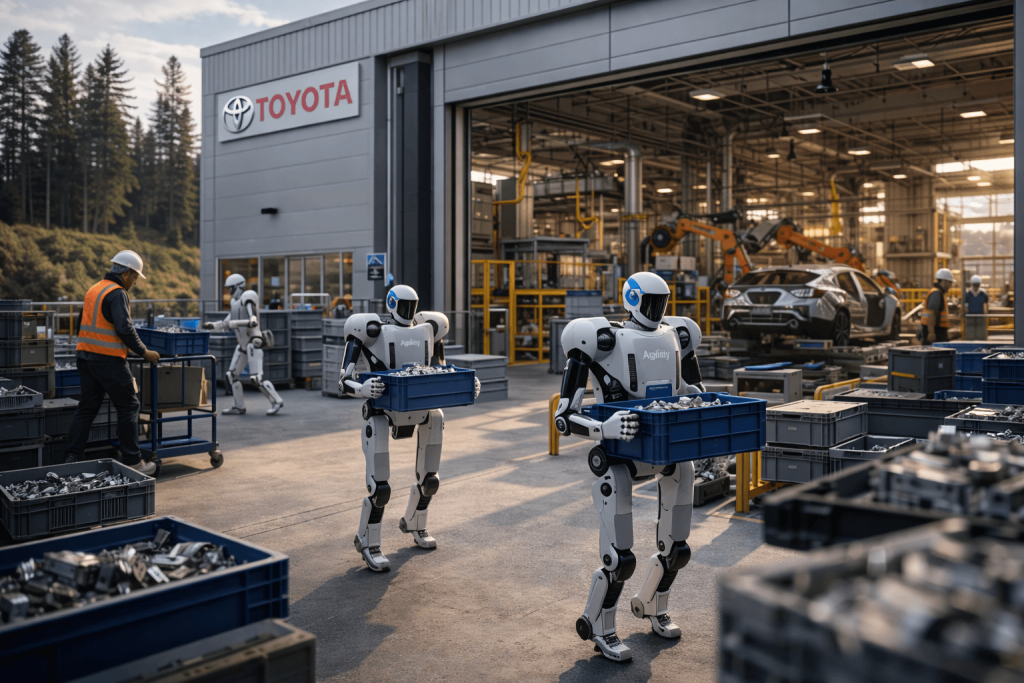
Humanoid robots are moving out of research labs and into real industrial environments.
Toyota has hired seven humanoid robots from Agility Robotics to operate inside one of its Canadian manufacturing facilities, according to a report from TechCrunch. The deployment marks a notable step in commercial adoption of bipedal robots designed to work alongside human employees.
While industrial robots have been common in auto manufacturing for decades, humanoid systems represent a different approach: machines built to navigate environments designed for people.
What Happened?
Toyota is deploying seven humanoid robots developed by Agility Robotics at a Canadian factory.
The robots — known as Digit — are designed to handle repetitive material-handling tasks, such as:
- Moving containers
- Transporting components
- Supporting warehouse logistics
Rather than replacing existing robotic arms, these humanoids are being used in roles that require mobility in human-oriented spaces.
Toyota has not disclosed the full financial terms of the agreement, but the move signals growing confidence in humanoid robotics for real-world industrial work.
Who Is Agility Robotics?
Agility Robotics is a U.S.-based robotics company known for building Digit, a bipedal humanoid robot designed for warehouse and factory environments.
Digit is built to:
- Walk on two legs
- Lift and carry objects
- Navigate tight industrial spaces
- Operate in facilities built for human workers
Unlike traditional fixed industrial robots, Digit can move across floors, climb small obstacles, and interact with existing layouts without requiring full infrastructure redesign.
Why This Matters
1. Humanoids Enter Commercial Deployment
Humanoid robots have largely remained in pilot programs and demonstrations. A seven-unit deployment inside a major automotive factory represents practical commercial use.
2. Factories Are Testing Flexible Automation
Automotive manufacturing is already highly automated. However, certain tasks — especially logistics and material transport — still rely heavily on human labor.
Humanoids aim to bridge that gap by:
- Handling repetitive, physically demanding work
- Operating safely near people
- Adapting to changing layouts
3. AI Enables Real-Time Decision Making
Modern humanoid robots rely on AI systems for:
- Vision and object detection
- Path planning
- Balance and motion control
- Task prioritization
Advances in AI and computing power have made real-time autonomy more reliable than in previous generations of robotics.
The Bigger Trend: Robotics Meets AI
Toyota’s move reflects a broader shift in robotics:
- Traditional automation = fixed, task-specific machines
- New-generation robotics = mobile, AI-driven systems
Several companies are racing to commercialize humanoid robots, including startups and major technology firms.
The promise is flexibility. Instead of redesigning factories for machines, machines are being built to function in human environments.
Risks and Open Questions
Despite progress, humanoid robotics still faces challenges:
- Reliability over long production cycles
- Maintenance costs
- Worker safety integration
- Return on investment
Seven robots in one facility is a meaningful step, but still a limited rollout. Large-scale replacement of human labor is not immediate.
Most experts expect gradual integration rather than rapid workforce displacement.
What’s Next?
Key areas to watch include:
- Expansion to additional Toyota facilities
- Performance data from real-world operations
- Broader automotive industry adoption
- Improvements in humanoid dexterity and payload capacity
If these robots demonstrate consistent performance, other manufacturers may accelerate similar deployments.
Conclusion: A Test Case for Humanoid Robotics
Toyota’s deployment of seven Agility Robotics humanoids is a clear signal that humanoid robots are moving from concept to commercial application.
The automotive sector has long been a testing ground for automation. Now it may become the proving ground for humanoid AI-driven labor.
Whether this marks the start of large-scale adoption will depend on performance, cost efficiency, and operational safety — but the experiment is now underway.
Key Takeaways
- Toyota has deployed seven Agility Robotics humanoid robots at a Canadian factory.
- The robots handle material movement and logistics tasks.
- This marks a meaningful commercial deployment of humanoid systems.
- AI-driven robotics is expanding into real industrial environments.
- Large-scale adoption will depend on reliability, safety, and ROI.